Showing posts with label Technology. Show all posts

Monday, October 24, 2011

Barco's R-360 Flight Simulation Dome - Crystall Ball

This here is Barco's R-360 flight simulation dome - Crystall Ball, though it's awfully close to being a sphere. It offers state-of-the-art visuals and full 360-degree views--much better than a lousy screen.

Immersive Flight Simulation Dome Offers Seamless, Super-Real 360-Degree Views

Barco, a maker of large-format projector technologies, has just unveiled what it is calling a breakthrough in flight simulator technology, and for all the hardware involved we’re inclined to agree that his must be something big. The new flight simulator dome--it’s really more like a sphere--offers state of the art high-res visuals and full 360-degree views, allowing fighter pilot trainees to spot other aircraft from 12 miles away.

That’s something of a step up from that flight simulator you used to play on your mom’s PC. The dome is bathed in light from 13 or 14 10-megapixel projectors, which are calibrated by laser to ensure complete crispness in picture. The projectors can also display imagery in infrared so pilots can train for night flights--wearing night vision, pilots actually see the blooming and halo effects caused by night vision technology.

That kind of realism is critical to ensuring pilots are prepared for real-world scenarios, the company says, and should help launch a new generation of similar simulators designed around a completely immersive experience in which several pilots can actually work together to carry out a mission rather than just run through a set of programmed scenarios.

Video: Immersive Flight Simulation Dome Offers Seamless, Super-Real 360-Degree Views


The setups are configurable and customizable so you’ll have to call up Barco if you want a price quote. The video below is mostly an extended commercial for the product, but it does provide some nice views from inside the cockpit.

Thursday, October 20, 2011

New Camera: Canon EOS-1D X Full-Frame Pro DSLR

Canon EOS-1D X Full-Frame Pro DSLR

Almost everything that was in Canon's new professional association designed from the ground up
This is New Camera: Canon EOS-1D X Full-Frame Pro DSLR. If you’re looking more pixels on the digital SLR Canon's new star want to look away from the EOS-1D X, due out March 2012. With its full frame sensor, the X-1D Mark III replaces the 1Ds and 1D Mark IV, the abolition of the APS-H-line from Canon. Although it has only 18 million effective pixels, it did not bother us at all.
 
By keeping the pixel count down, matching the sensor with a pair of Digic 5+ image processors and with the help of a hefty buffer, the 1D X offers full burst capability at up to 12 frames per second, or up to 14 fps when shooting JPEG-only with the mirror and AF locked.

Fewer pixels also means larger pixels‹another plus. The 1D X¹s are 6.95 microns in diameter, 22% bigger than the 1D Mark IV¹s. With this increase comes a top standard ISO of 51,200, expandable essentially to ISO 204,800; minimum sensitivity is ISO 50, down from ISO 100.

As if that weren¹t enough, Canon has completely revamped the rest of the camera¹s features. This includes a new 100,000-pixel RGB metering sensor powering a 252-zone system that works together with a new 61-point (41 cross-type) AF system to track subjects by shape and/or color. The 1D X¹s new interface makes it easier to manage how the AF functions. And it sports many customizable buttons, including four next to the lens on front of the body.

The camera body itself retains pro-level weather sealing, but it does away with the SD card slot in favor of two CF slots. The LCD is now 3.2 inches with 1.04 million dots. The shutter uses lightweight carbon-fiber blades that increase its life to 400,000 cycles (up from the 1D Mark IV¹s 300,000). 

The body also includes a Gigabit Ethernet port for faster tethered shooting. Video reaches 1920x1080/30p or 1280x720/60p saved as H.264 .mov files, but you can also choose either low-compression ALL-I or high-compression IPB.

It's slated for arrival in March 2012, bringing with it a price tag of, get ready for it, $6,800. But, hopefully we'll see some of the cooler features tirckle down into the lower models in the not-too-distant future.
 

Sunday, October 16, 2011

Interchangeable Lens Cameras of Nikon J1 and V1

Nikon has been very quiet about his newest camera, but tonight he pulled the curtain and revealed a pair of compact cameras with interchangeable lenses that the company put into full force in the War Coalition. This is Interchangeable Lens Cameras of Nikon J1 and V1. The value of the two chambers by a 10.1-megapixel CMOS sensor, which Nikon called the turn, the size of the CX. 13.2 mm x 8.8 mm is less than the third contest of four, but larger than the next Pentax system Q. This is a factor of 2.7 in the general culture, which comes into play when the F Mount Adapter.


Interchangeable Lens Cameras of Nikon J1 and V1

One of the main talking points for Nikon about the sensor is its ability to do focal plane phase detection AF at hugely fast speeds. When phase detection is wrong for the shooting situation, it automatically switches to contrast AF for speed. First impressions from technical editor, Phil Ryan suggest that it's fast, but not really noticeably faster than Micro Four Thirds in terms of AF. It also helps that it has 73 AF points in phase detection mode. That's a serious array -- more than any other interchangeable lens camera according to Nikon.

Image processing is handled by the Expeed 3 processor, which allows for a burst rate up to 10 fps with AF tracking.

One of the big new stories here is the introduction of the Nikon 1 lens mount. At launch, the J1 and the V1 will have the 1 NIKKOR VR 10-30mm f/3.5-5.6, 1 NIKKOR VR 30-110mm f/3.8-5.6, 1 NIKKOR 10mm f/2.8 and 1 NIKKOR VR 10-100mm f/4.5-5.6 PD-ZOOM. The FT1 mount adapter will allow you to slap any F-mount lens on a 1-series body, which may be a substantial advantage considering their current user base.

There are two models to choose from: The V1 and the J1. The V1 is the higher-end model and includes an integrated electronic viewfinder with 140k dots of resolution. It covers approximately 100% of the frame. It also has a 921k dot TFT LCD display, a mechanical shutter and a flash sync speed of 1/250th of a second. All of that is wrapped up in a magnesium alloy body tougher than that of the J1.

The J1 loses the integrated viewfinder and drops the resolution of the LCD display to 460k dots. It also has an electronic shutter, to help keep the price down.

Interchangeable Lens Cameras of Nikon J1 and V1  
 
The V1 also has the advantage of an accessory shoe into which you can plug a flash -- neither have one built-in -- or a GPS module, neither of which have received official pricing info yet. The J1 has a pop-up flash to make up for its lack of shoe.

Nikon has also spruced up the shooting modes in their new little cameras, some of which blur the line between photography and video capture. Both cameras can capture 1080p video at 60i with simultaneous still image capture at full-resolution.

The Motion Snapshot mode records "about a second" of video footage surrounding the shutter press. It's recorded at 60fps and plays back at 24fps. It actually sounds a lot like a non-repeating cinemgraph.
Both cameras will be available October 20th. The cheaper J1 will cost $649 and come packed with the 10-30mm zoom lens. The V1 will cost $899 packaged with the same lens.

Wednesday, October 5, 2011

Dark Energy Won The Nobel Prize in Physics

Scholarships today with the Nobel Prize for Physics, which was almost a matter of time, not if. When the three winners and their teams in 1998 have been announced that the universe is expanding, not only, but the acceleration has shaken the basic cosmology: The results, said the world would be with a bang but end with a groan. Dark Energy won the Nobel Prize in Physics.

Composite Image of the Tycho Supernova Remnant X-ray
Dark Energy Won The Nobel Prize in Physics 

And the question of why - the mysterious force of dark energy, which represents about three-quarters of the mass-energy of the universe - is one of the great questions of modern science.
Saul Perlmutter, Brian Schmidt and Adam Riess was common for his discovery that the universe is growing at a rapid pace. They used ground-based telescopes and space to represent the supernova of Type Ia further and found this star exploded seemed calmer than he was. Ias type are used as standard candles, because astronomers know that their brightness, which is very consistent, and you can use to measure their distance from us.

However, measurements have shown that these standard candles are not bright enough, but faded. Something happened, and could easily the technology, or perhaps due to the calculations. But the two teams - is the same - the Supernova Cosmology Project and the Research Team of High-z Supernova. The data showed that the standard candles away at a rapid pace.

It was a surprising discovery. Everyone knew, since Edwin Hubble that the universe was thrown out after the Big Bang 13700000000 few years. But for the acceleration? It meant something else was at work, a force far more mysterious and strange than we had thought. Nobody knows what this power is, but after ten years of calculations, the physicists know that about 74 percent of the universe. "We call it dark energy to express ignorance," Perlmutter said in a conference I attended in 2008.

The work is interesting in itself, but physicists are also match some of the young scientists evangelists. Perlmutter, 52, is a lively and enthusiastic speaker, the exact kind of person you want to explain terms such as "baryonic oscillation", and significant melting. He continued his research on dark energy as a senior scientist at Lawrence Berkeley National Laboratory. He wants a supernova observatory, "Everyone was talking about the constructed dark energy, but no nothing about it" Supernova Acceleration Probe (SNAP), as a project of the Works Progress Administration, told Time.

Riess, who is only 41, is an astronomer at the Space Telescope Science Institute and a professor at Johns Hopkins. It is also the recipient of a grant from the MacArthur Foundation genius and numerous awards for his work in cosmology.
Schmidt, who is 44 and works at the Australian National University, took some of the calculations that the results of Riess checked.

I have Perlmutter card on my desk, and you speak is one of the reasons why I wanted to travel and things like the cosmological constant to write. These are important things - the eternal nature and future of all things, and yet enigmatic and mysterious, but almost, because by Perlmutter, Riess and Schmidt, recognizable truth.
"The results of the 2011 Nobel Prize in Physics have contributed to create a universe that science reveals largely unknown," wrote the Nobel Assembly. "And everything is possible again."

Saturday, October 1, 2011

767 Horsepower - Porsche 918 RSR Hybrid Introduced in Detroit

The Auto Show in Detroit is the launch this morning, and the first news of the exhibition hall is the Porsche 918 RSR, a hybrid supercar that not only the design features of its predecessors as the sexy 911 , 908, and of course, the 918 Spyder, but that churns 767 horsepower for a total of between gasoline and electric motors. With proudly: 767 horsepower - Porsche 918 RSR Hybrid Introduced in Detroit.

767 Horsepower - Porsche 918 RSR Hybrid Introduced in Detroit

The body of carbon fiber reinforced RSR 918 hides some interesting stuff behind the wheel muscular, wells, and the curvature aerodynamics. Under the hood, a 10,300 RPM direct-injection V8 offers 918 RSR, with its primary impulse of about 563 horses. But each of the front wheels still contributes 75 kilowatts of electrical power for the driver, resulting in a cumulative total of 767 horsepower at the drive end.

 
Then there is the battery of the equilibrium is located next to the driver in the passenger seat sat the wheel stores energy captured when the vehicle brakes. This energy can be accessed by two 102 horsepower electric motors at the touch of a button, providing a burst of acceleration when needed.


The Porsche 918 RSR, Interior - 767 Horsepower Porsche 918 RSR Hybrid

When can it be necessary to power? Porsche did not say exactly when and where the hybrid 918 RSR run, but it is designed for events such as Le Mans 24 hour race and road races as a supplement to help with stored energy can help in passing maneuvers and by providing a way for drivers trying to pass the symbolic RSR middle finger.
 
We have included Porsche did above and below, but Inhabitat has a great gallery of the car at the Detroit show floor.

Thursday, September 29, 2011

Canon PowerShot S100 Review - Advanced Compact Camera

Canon S90 and S95 successor soon carved a nice little segment in the compact class. A fast lens and a superb performance in low light, all in a subtle body is smaller than a pocket camera is ideal for advanced shooters. Canon has released the updated version of the S100, and it seems they are still on track. This is Canon PowerShot S100 Review - Advanced Compact Camera.


Most of the good things stuck around, and often not even seen an improvement. The goal remains, to f / 2 at its widest focal length to open, but now has a 5x optical zoom, compared to 3.8 x of the S95. This gives you a full size field is 24-120mm.
 Canon PowerShot S100 Review - Advanced Compact Camera

The S100 is still part of the Canon SA, but the image sensor and processor performance increases were achieved. The sensor is now a 12.1-megapixel CMOS (s up to 10 megapixels S90/95 "CCD) and is the new DIGIC image processor 5, which Canon claims faster, better in low light and you get more accurate color reproduction.

RAW support has shifted to how the ring set touch controls on the front of the camera to different camera settings to handle operations.
As expected, Canon and more intelligent system for the first time in August, when he made the PowerShot ELPH SH 510 known. The S100 is equipped with six different modes of the device selects the recording conditions are most suitable.
 Canon PowerShot S100 Silver - Advanced Compact Camera

Video recording was pinched up to 1080p, with a maximum has been ISO 6400 and pushed the LCD screen remains 3 inches.

Also new is an integrated GPS for geotagging of origin. The GPS recorder keeps track of their course during the day to help you again with the included software and check his career as a shot.

Tuesday, September 27, 2011

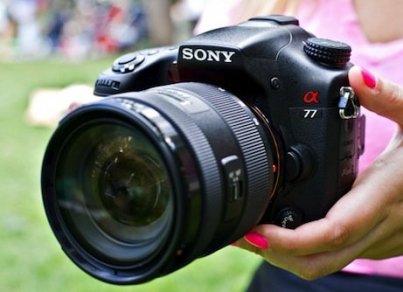
SONY A77 and A85, Fast-Firing and NEX-7

Sony announced a pair of new DSLRs in their Alpha line now known as the A77 and A65. Like our sister publication issued photo Pop Sony A55 Camera the Year Award in 2010, Try to know about detail SONY A77 and A85, Fast-Firing and NEX-7. I mount up and notice every time Sony launches new flagship DSLR - and I look forward to do to have this time, because those are some impressive camera.

Sony A77 - hands on, SONY A77 and A85, Fast-Firing and NEX-7   

Both are equipped with the latest technologies from Sony Translucent Mirror basically a new type of camera that our colleagues in Pop Photo love. You can read a more detailed description of the technology and why it is amazing here, but basically the idea that (to save instead and change the video mode) through the use of a translucent mirror image so that the Sony cameras legitimate video autofocus. 

The A77 high-end with the latest version of translucent glass, making the world's fastest auto-focus Continuous shooting (and the 24-megapixel large) total catch image-base to 12 frames per second (the A65 is 10 fps).

The display, another highlight of the last Sony Alpha cameras will also receive an update - this time for a high-resolution OLED display. Instead of an optical viewfinder, turn on the digital configuration settings and all types of masks, so you do not remove your eyes and spend time on the LCD screen of the device quickly you change your aperture or white balance.

A surprising amount of technology in the Alphas, but the new Sony compact interchangeable lens, the NEX-7, the predecessor of the carried out as one of the best cameras in place last year. It has the same 24.3 megapixels and the processor itself, that large.

And made a gallery of photos with them as photographers had the good fortune to play with these cameras for a few days now - you can read more about the Pop NEX-7, A77, A65 and more images. The A77 has a fee of $ 1.400 and A65 for $ 900 only with the body - no lens included. The NEX-7 for a period of $ 600, a single point.

Sunday, September 25, 2011

Microbots Spin Molecules, Repairing human body to Swim Through Blood Vessels

Imagine if the technology in the film actually became a reality. This is one of them. Advances in technology micro-robots could be created for health purposes. Microbot molecular spin is the name given to this micro robot. Microbots Spin Molecules, Repairing human body to Swim Through Blood Vessels.
A lopsided self-propelled micromotor could drive itself through blood vessels, making repairs or delivering drugs along the route, according to researchers at Penn State. The small particles leach out a trail of material, like a microspider spinning a thread.

Microbot Spin Molecules -Amyloidosis in Blood Vessels Pulmonary Pathology

The motors turn on, as it were, when one side of a Janus microsphere grows a suite of molecules on one side. Eventually, the lopsided sphere creates an osmotic gradient. As fluid flows toward the area with fewer particles, the whole sphere moves.

Janus microspheres have two distinct hemispheres made of different substances. In this case, one half is gold and the other is silicon dioxide. Researchers led by Ayusman Sen at Penn State attached a molecule called a Grubbs catalyst, which induces polymerization, to the silica side. Then they added a monomer, which the catalyst strings into long chains. The monomer strings gather on the SiO2 side, which creates a mini current that sends the whole sphere moving the opposite direction.

To prove it can deliver substances, the scientists filled a gel substance with the monomer, which was slowly leached out. The micromotors moved toward the gel stream, like a single-celled organism following a trail of nutrient breadcrumbs.

This could be a handy, electricity-free way to send tiny devices into the bloodstream to do various tasks. The microspider motors could drive nanorobots that destroy tumor cells, or they could target drugs to specific organs more quickly, for instance.

Micromachines in the Bloodstream: 
The micromotors use a catalyst that binds asymmetrically to a Janus (two-sided) microsphere

The research is reported in the journal Angewandte Chemie.